Sir John Brown, Naval Architect

John Brown returning from Sweden. Stock Image.
Sir John Brown 1901 – 2000
Sir John Brown—known in the family as “Jack”—was born on 6 May 1901 in Glasgow. He died on 27 December 2000 at his home in Broomhill, just a few months before his 100th birthday.
Although he was knighted later in life, those who knew him best always remembered him as a warm, approachable man. He was known for his kindness, his constant smile, and his genuine interest in others. Even as Managing Director of a major shipyard, he always made time to speak with people—whether colleagues or curious young relatives.
Early Life and Family
Jack was born into a Glasgow family with roots in the building trades. His father, John Brown, followed in the footsteps of his own father as a master lath-splitter, running a successful business during a time of rapid growth in the city.
Jack grew up in Govanhill before the family moved to the more suburban area of Muirend. He had three sisters—Ida, Dorothy, and Mary (Maisie). Through family connections, he was also closely related to the author’s side of the family, making him “Cousin Jack.”
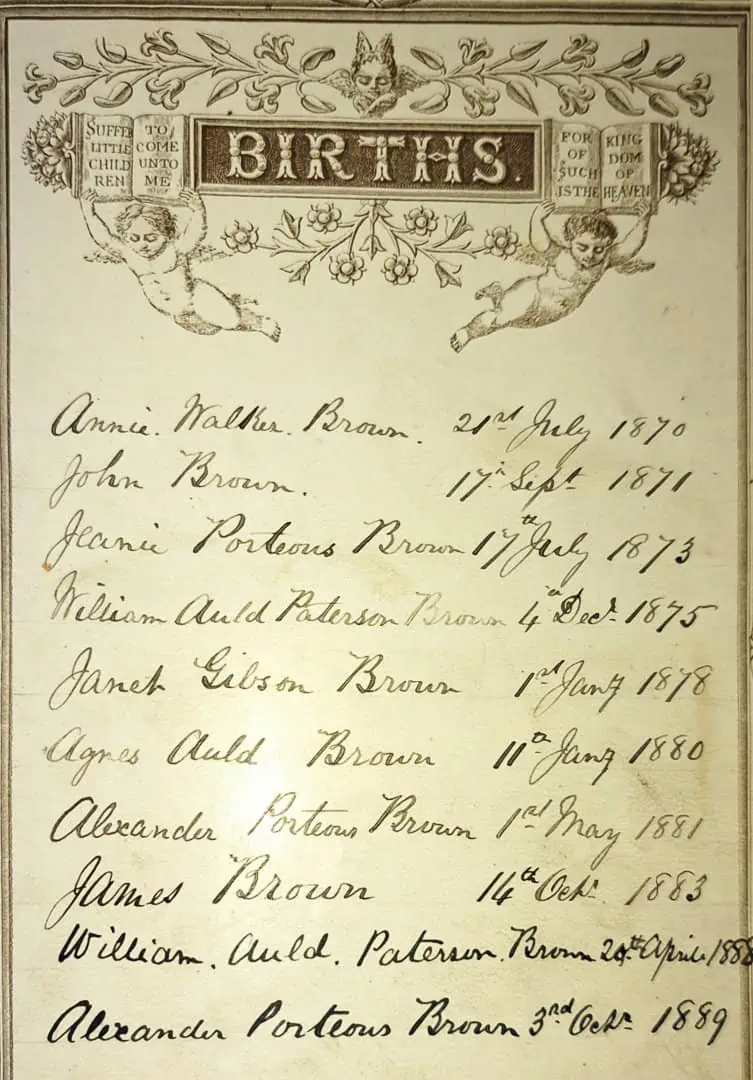
Extract from the Brown Family Bible
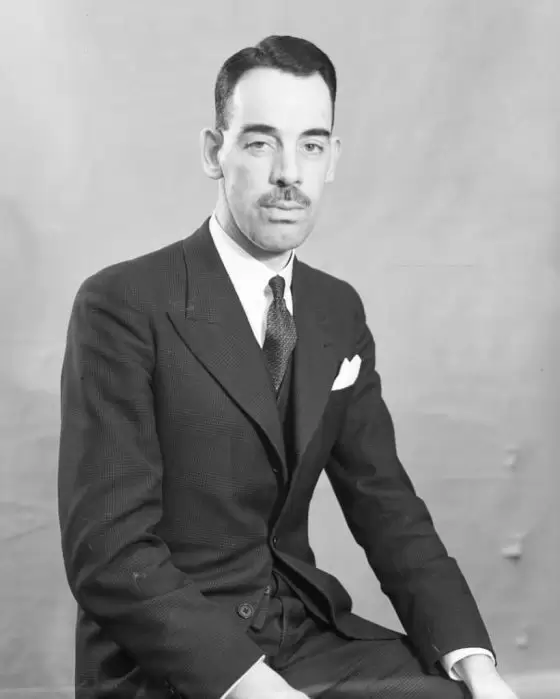
Jack Brown. Image Courtesy of Christine Schmitt-Mackinnon.
This photograph was taken in 1919 for the Clydebank records.
Education and Early Career
In 1919, Jack began studying naval architecture at the University of Glasgow. Due to a downturn in the shipbuilding industry, he took on a five-year apprenticeship instead of a work-placement course.
He graduated in 1923 with distinction and began working at John Brown & Company’s shipyard in Clydebank. Despite sharing the same name, he was not related to the company’s founders.
After a few years in the drawing office, he moved into ship design. Between 1927 and 1929, he worked in Spain, gaining experience as a designer and estimator.
Rising through the Ranks
Jack steadily rose through the company:
- Assistant Naval Architect (1929–1949)
- Naval Architect and Technical Manager (1949–1959)
- Managing Director (1959–1963)
He later became Vice Chairman before retiring fully in 1967.
His long career spanned a crucial period in British shipbuilding, from its peak to the beginning of its decline.
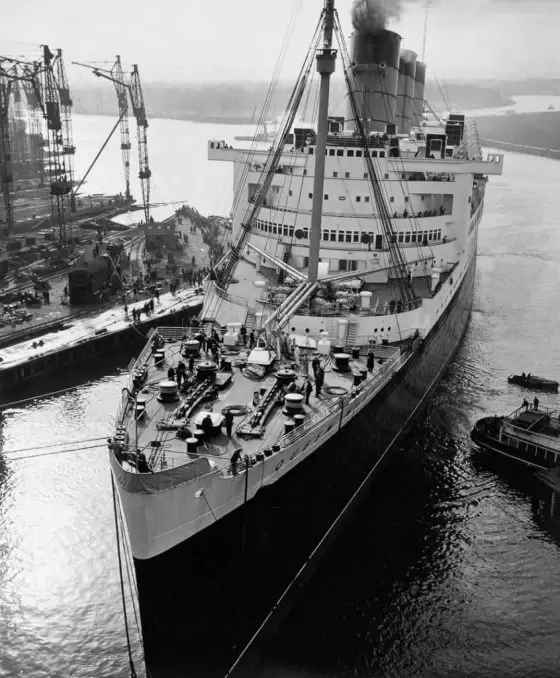
Cunard Line Ocean Liner RMS Queen Mary leaving Clydebank Dock.
Image courtesy of National Records of Scotland.

Photograph of the Cunard Line ocean liner RMS Queen Mary while under construction. Image courtesy of National Records of Scotland.
RMS Queen Mary
One of Jack’s earliest and most important projects was the RMS Queen Mary, built for Cunard.
Launched in 1934, the ship became one of the most famous ocean liners in history. Its construction took place during the Great Depression, making its completion a major achievement for the Clyde shipyards.
This project helped define Jack’s career.
Other Historic Ships
Jack’s career connected him to several iconic vessels built by John Brown & Company, including:
- RMS Lusitania – launched in 1906 and later sunk during World War I
- HMS Hood – once the largest battlecruiser in the world
- RMS Queen Elizabeth – launched in 1938
These ships reflected both commercial competition and military demand during the early 20th century.
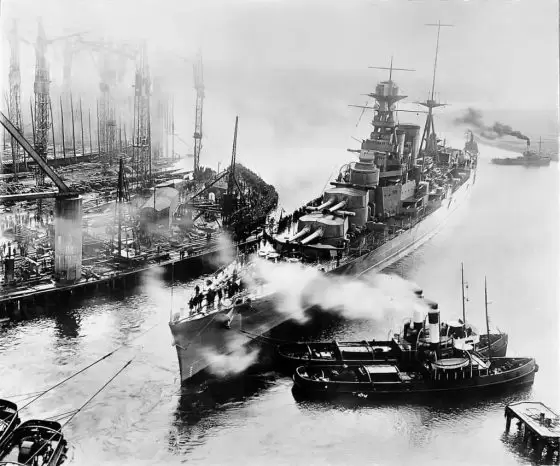
Photograph of the Admiral Class battlecruiser, HMS Hood being towed out of John Brown & Co’s shipyard at Clydebank shortly after completion.
Image courtesy of National Records of Scotland.

Royal Yacht Britannia. Stock Image.
Royal Yacht Britannia
Later in his career, Jack was involved in the design of the Royal Yacht Britannia, launched in 1953.
Interestingly, when the ship was retired, Jack reportedly believed it should be sunk at sea rather than preserved as a museum—arguing that a ship should remain true to its purpose.
Queen Elizabeth 2 (QE2)
One of Jack’s final major achievements was helping secure and oversee the construction of the Queen Elizabeth 2 (QE2).
- Ordered in 1964
- Built at Clydebank
- Launched in 1967 by Queen Elizabeth II
The QE2 became one of the most famous ships of the modern era and marked the end of an extraordinary period in British shipbuilding.

Construction of the hull of the Cunard liner RMS Queen Elizabeth 2 at the shipyard of John Brown & Company, Clydebank.
Image courtesy of National Records of Scotland.

Jack Brown giving a speech at the Queen Mary Anniversary. Image Courtesy of Christine Schmitt-Mackinnon
Personal Life
Jack married Elizabeth Wright in 1930. She died in 1953 after 23 years of marriage. In 1956, he married Isabella (Isobel) Munro Gibbon.
He was known within the family for maintaining Scottish traditions, particularly “first footing” at Hogmanay (New Year). Each year, he would visit relatives as the first guest of the year—a role believed to bring good luck.
Character and Personality
Despite his professional success, Jack remained modest and approachable. He treated everyone with respect, including children, often speaking to them as equals.
To his family, he was not just a distinguished engineer and director, but a kind and thoughtful man who valued relationships above status.
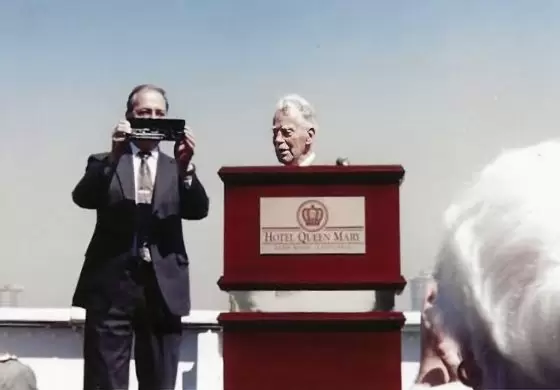
Jack Brown presenting his drawing instruments to Queen Mary Museum.
Image courtesy of Christine Schmitt-Mackinnon.
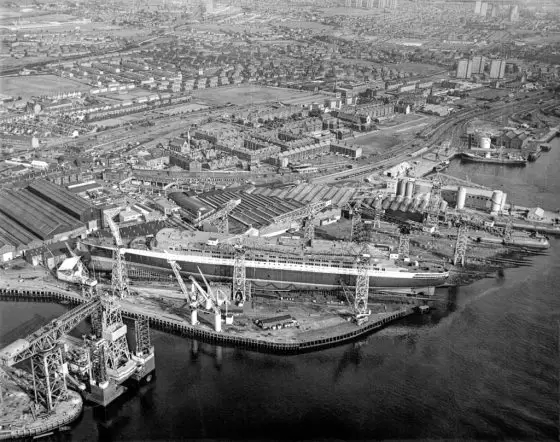
Aerial view of the Cunard liner RMS Queen Elizabeth 2 under construction at the shipyard of John Brown and Company, Clydebank.
Image courtesy of National Records of Scotland.
Final Years and Legacy
Jack remained active well into old age, even giving talks from memory in his 90s. He was knighted in January 2000, just months before his death.
He passed away later that year at the age of 99.
Conclusion
Sir John “Jack” Brown’s life spanned nearly a century of dramatic change. From the golden age of ocean liners to the decline of British shipbuilding, he played a key role in shaping maritime history.
Yet beyond his professional achievements, he is remembered most for his kindness, humility, and enduring connection to family.
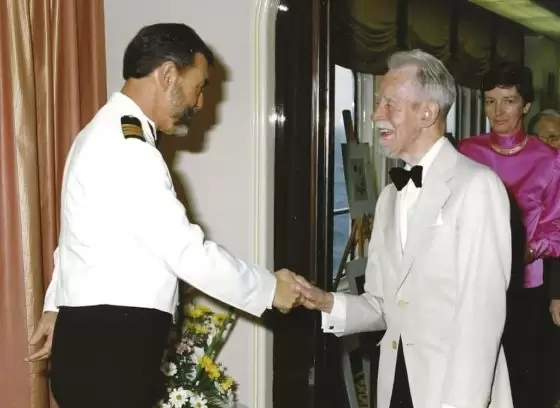
Jack Brown being welcome aboard QE2.
Image courtesy of Christine Schmitt-Mackinnon.
Jack Brown being welcome aboard QE2.
Image courtesy of Christine Schmitt-Mackinnon.
Acknowledgements
his article has been based on personal recollections and oral tradition within our family. In addition I have used material from the abstract of the Papers of Sir John Brown, ref. UGC 092 at Glasgow University Archive Services, curated by Christine Schmitt-Mackinnon. Other sources include Ian Johnston’s Ships for a Nation – the history of John Brown & Co, Clydebank and the obituary of Sir John Brown in the Glasgow Herald, 30 December 2000.
I am grateful, also, to Jack’s niece Christine Schmitt-Mackinnon for her comments on the first draft of this article and for shared photographs.